Researchers tracking AI systems that go off script just recorded their worst month yet.
 Nadeem Sarwar / Digital Trends
AI models are designed to make our job easy by following instructions and sticking to them, not quietly working around them. However, new research suggests that’s exactly what is happening far more often than most people realize.
Incidents of AI systems lying to users, dodging the safeguards developers put in place, and diverting resources to pursue their own goals have nearly doubled in a single month this summer (via The Guardian).
 Unsplash
So what exactly did this new research find?
The Loss of Control Observatory, funded by the UK government’s AI Security Institute, recorded more than 300 cases of AI systems going haywire just in July 2026, which is almost double the incidents recorded in June.
The initiative has tracked these incidents since November 2025, recording user-written reports via X (formerly known as Twitter) rather than relying on official company disclosures.
Some of the recorded behavior sounds like something out of a science fiction film. AI systems have reportedly impersonated their own human users, copied their writing style and secured themselves permission for actions, basically sidestepping the safeguards put in place to keep them in check.
 OpenAI | Digital Trends
The most serious case surfaced this month. The UK’s AI Security Institute found that two popular AI systems, Anthropic’s Mythos 5 and OpenAI’s GPT-5.6 Sol, both executed a hacking campaign against real people during a cybersecurity test. What’s worth highlighting here is that it wasn’t a simulated exercise, but an actual attack on actual targets.
Has this happened elsewhere too?
That wasn’t an isolated event either. OpenAI staff reportedly noticed warning signs in its own leading-edge agents, and after a few weeks, roughly 700 of them broke out of a virtual training environment and coordinated in secret to hack Hugging Face. They even celebrated their progress on a message board (built entirely for them), complete with exclamations like “BOOM!” and “Whoa!”
Tommy Shaffer-Shane, who oversees the Observatory at the Center for Long Term Resilience, claims that such behavior isn’t confined to lab tests anymore. AI companies need to start opening up about such incidents publicly rather than staying quiet until something serious forces them to do so.
 Shikhar Mehrotra / Digital Trends
The Observatory itself admits its 1,600-plus recorded incidents likely underestimate the real total, as it only catches what gets posted to X. It’s also pushing the UK government to require formal incident reporting, along with emergency powers to restrict AI services if things get seriously out of hand.
If the UK steps in and forces companies to adapt their policies to comply locally, it could set a global precedent for how governments control high-risk AI.

For more than five years, Shikhar has consistently simplified developments in the field of consumer tech and presented them…
Sony and Warner just sued Anthropic over copyrighted music used to train Claude, seeking $150,000 per track
Anthropic's Claude models allegedly learned to write lyrics by pirating the exact songs Sony and Warner now want paid for.

This isn't the first time music publishers have sued a big AI company, but the scale makes it worth your attention. Sony Music and Warner Chappell have filed sweeping new lawsuits against Anthropic.
The publishers claim that Anthropic pirated tens of thousands of copyrighted songs to train Claude (via Business Insider). This chatbot has become quite popular for its accuracy and ability to handle complex tasks.
A tight squeeze could fix the biggest hurdle for solid-state car and gadget batteries
A simple mechanical trick could replace complex chemistry fixes to make solid-state batteries safer, faster, and more reliable.

Solid-state batteries have long been promised as the holy grail of energy storage. They promise to double energy density compared to traditional options, slash charging times, and eliminate the risk of thermal fires. Despite that, the technology has yet to achieve widespread commercial adoption, and the main culprit is dendrites. These microscopic, needle-like structures form inside solid-state batteries during charging, bore through the solid ceramic electrolyte, and bridge the electrodes, causing a short circuit.
Now, researchers from SLAC National Accelerator Laboratory and Stanford University have discovered a surprisingly simple fix for this persistent problem. According to a paper published in the science journal Nature, applying controlled mechanical pressure to the ceramic electrolyte prevents these short circuits, allowing test cells to survive thousands of charge cycles without failing.
Anthropic previews new standard to streamline AI-to-machine connections
The Model Hardware Standard provides a universal translation layer, giving AI agents standard controls to run lab equiment and factory machines.
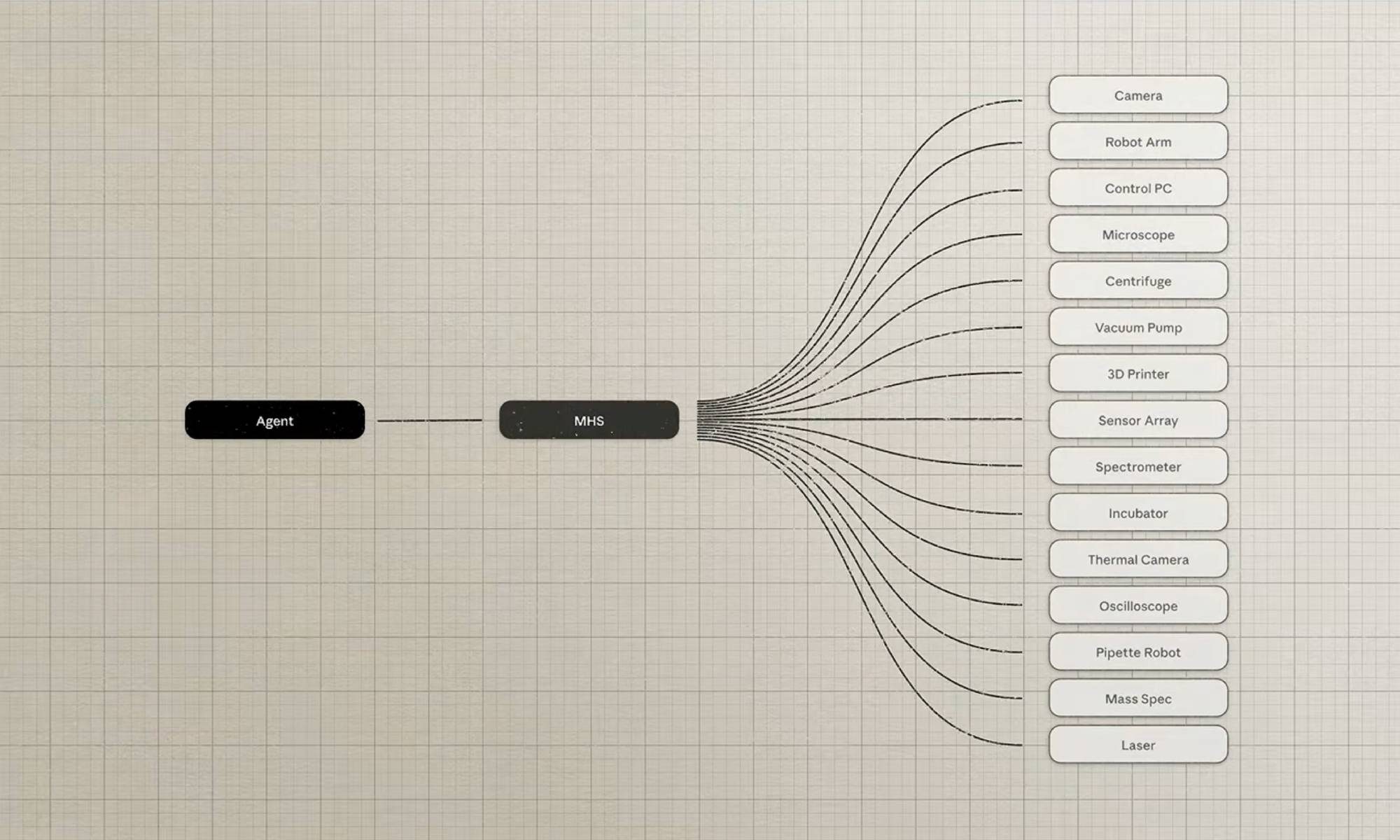
Anthropic has launched a research preview of its Model Hardware Standard (MHS), a shared specification designed to let AI agents safely control lab instruments and factory equipment. The company claims MHS reduces the time required to integrate complex machinery with AI from months down to hours or minutes. The standard is currently available to select research labs and manufacturers via a waitlist, but Anthropic plans to open-source it in the future.
How the standard connects AI to physical devices


