 Nirave Gondhia / Digital Trends
It’s no mystery that the iPhone works best with an Apple Watch. But Apple takes the contrary approach with smartwatches and accessories from other brands, limiting certain features while using security as a shield. This has upset the lawmakers at the European Union, who have now instructed Apple to enable better harmony between the iPhone and third-party accessories under the Digital Markets Act (DMA).
The European Commission recently passed two resolutions, compelling Apple to honor the interoperability clause in the DMA. It enforced that Apple must allow “deeper and more seamless integration of third-party products with Apple’s ecosystem.”
The Commission has listed nine connectivity issues in iOS that Apple must address in order to allow better support for devices including smartwatches, headphones, or TV. These changes are expected to allow apps to get better access to information from the iPhone, faster speeds, and simplified means of pairing.
Please enable Javascript to view this content
For smartwatches specifically, this would mean third-party smartwatches will be able to interact better with the iPhone. One vital implication of this would allow these watches to reply to notifications from iPhone, which Apple currently prohibits. Pairing with the iPhone, the EU imagines, should also be easier for non-Apple smartwatches.
How Apple limits third-party smartwatches
 Core Devices / Digital Trends
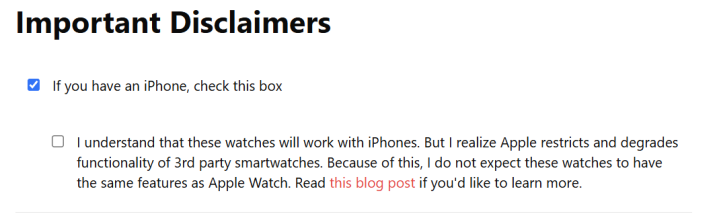
Pebble, which, after being bought by Fitbit and then shut down, recently re-emerged with new watch options. But with the launch, the makers of the new Pebble emphasized different ways Apple handicaps third-party watches. These include limitations in viewing and reacting to notifications, sending messages in Apple Messages, limiting wrist-bound notifications when you are using the iPhone, among other issues, all of which are listed in a blog.
The EU expects Apple to release technical documentation on features, which, if delivered adequately, should be expected to mitigate some of the issues Pebble lists. The order says these decisions are “legally binding,” and expects Apple to share a timeline to implement the changes.
The actual implementation, as we witnessed in the iPhone’s complete transition from Lightning port to USB-C, could be a matter of months, if not years. For now, Apple appears hesitant and called this an attempt at “slowing down Apple’s ability to innovate for users in Europe and forcing us to give away our new features for free to companies who don’t have to play by the same rules,” in a statement to The Verge.

Tushar is a freelance writer at Digital Trends and has been contributing to the Mobile Section for the past three years…
Apple’s folding iPhone may actually be happening

The idea of a folding iPhone has circulated the web for quite a while now, with many estimates placing its arrival in 2026. Apple has filed numerous patents, all of which point toward the idea of a folding device, but there hasn't been anything that pointed toward it being an in-development project rather than just an exploratory probe. Now, new information from a trusted source suggests that could be about to change.
Apple has recently entered the "formal development process with display manufacturers," according to Yeux1122. The tipster says their source for this information is an unspecified supply chain source. The original post is in Korean, so all our information comes via Google Translate.
A hidden iOS 18.1 upgrade made it harder to extract data from iPhones

Apple Intelligence was the most notable upgrade that arrived on iPhones with the iOS 18 series of updates. But it seems Apple reinforced the security protocols in the background that could prevent bad actors from gaining unauthorized access to iPhones that haven’t been unlocked in a while by their legitimate owner.
Earlier this month, 404Media reported that law enforcement officials are troubled by iPhones that are mysteriously rebooting. Citing a report courtesy of officials in Michigan, the outlet notes that the reboots are hampering the ability to access what’s stored on the phones through brute-force unlock methods.
iPhone 17 series could finally end Apple’s stingy era of slow screens

Apple has played a relatively slow innovation game when it comes to display upgrades on its phones. The company took its own sweet time embracing OLED screens, then did the same with getting rid of the ugly notch, and still has a lot of ground to cover at adopting high refresh rate panels.
The status could finally change next year. According to Korea-based ET News, which cites an industry source, Apple will fit an LTPO (low-temperature polycrystalline oxide) screen across the entire iPhone 17 series, including the rumored slim version and the entry-point model.